Tuesday, 18 November 2014

Much Ado About Drought

Despite all our hard work, Demarest (2001) states that decades of investigation have shown that diseases and foreign invasion are increasingly unlikely to be the cause of collapse.

So we need to look further – the remaining hypothesis surrounding this collapse is climate change.
There has been much debate over the timings and duration of climate change over the Classic and Terminal Classic period. I’ll just briefly outline the changes in understanding, to provide a basis for exploring arguments proposing climate change as a cause which will be covered over the next few posts.

Disagreements over drought. Source: Goose


Hodell (1995) presented evidence from lake sediment ‘implying’ (Hodell et al (2005) that a ‘mega-drought’ had occurred over the Terminal Classic Period which had great spatial extent and lasted between 50 - 208 years.

Several authors (including Carleton et al, (2014) and Lane et al (2014) whose arguments will be looked into in my next post) discount this theory with the support of independent palaeoclimatic evidence.

However recently Hodell et al (2005) has claimed that this work was misinterpreted and now presents evidence that the Yucatan Peninsula experienced multiple drought-wet cycles, which agrees with other academics’ work.


So stay tuned – I’ll be covering the aforementioned authors’ arguments over the next few posts!

Saturday, 15 November 2014

Trade No. 2

Just a quick one – I found this other article by Turner andSabloff (2012) who have developed ideas of trade and also argue that changes to trade routes was a key cause in the Maya collapse.

They go further than Golitko et al (in the last post) and say that the shift to coastal trade was as important, if not more so, than any environmental change. Although they accept that other factors were important, they point out that there must have been more at play than just drought/invasion. They ask why the Mayans didn’t return to their original settlements once the climate had returned to ‘normal’ conditions that they were well adapted to.


This highlights the point that no single factor can cause collapse/abandonment (disproving Environmental Determinism) and that the collapse of trade networks is a valid argument for collapse.

Source: Acting Man

That ship has sailed - changes in trade networks

More and more evidence is cropping up which supports the theory of changes in trade networks as a cause of collapse. Golitko et al, (2012) analysed abundances of obsidian (volcanic rock often used for tools or weapons) from 121 Mayan sites to demonstrate changes in social networks.

An example of a Mayan obsidian sacrificial knife. Source: Galleryhip

Their findings show that a shift in trade networks occurred around the time of Mayan collapse with a switch from terrestrial to sea-borne trade. This meant that proximity to the coast became vitally important in maintaining economic and political influence. As the importance of coastal trade and coastal networks increased, inland trade networks were no longer needed and collapsed (although I would have thought some networks would still have been useful). As a result the city of San Jose, which was once the main point of obsidian exchange, became much less significant.

Illustrations of the difference in obsidian supply sources between Classic and Terminal Classic periods, from Golitko et al (2012)


The trade of marine goods also became much more important and Golitko et al suggest that the Mayans may have ‘missed the boat’ on exploiting marine products due to their main settlement being in the central Yucatan Peninsula. This reduced access and connection to coastal imported goods resulted in diminished influence and power of the Mayans. Reduced economic stability may have led to increased social tension (and possibly conflict) and undermined the authority of the Maya elite.

I think that this theory could in part provide an explanation for the Mayan collapse. Of course no single factor would have brought a civilization such as the Maya down. However it is easy to see how changes in trade networks of a highly valuable commodity, which Golitko et al argue the Mayans were reliant on, reduced political and economic influence and pressures from other factors (e.g. invasion, disease, climate change) could have led to collapse.

Next time I'll be talking about the role of climate change!

Wednesday, 12 November 2014

Red alert - Invasion

Certainly the idea of an entire civilization being brought down by an epidemic outbreak is fairly exciting and in some ways relevant to today (it would definitely give many people a reason to overly freak out about the current Ebola outbreak).

But in the case of the Maya, there were probably other forces at play.

Sabloff and Willey (1967) argue that a foreign invasion by non-classic Mayans was ultimately the cause of the Maya collapse. They propose that the Mayans were invaded from the west by Mexicans and from the north by people from the Gulf of Mexico lowlands, just before the end of the Classic Period. They draw attention to the fact that they believe the Maya had not started to decline at the time of invasion, suggesting that it was the invasion itself which led to the fall of the Maya. This invasion would have led to warfare between surrounding populations and would have lasted several years.
An idea of what an invasion might have looked like... Source: ByCommonConsent


This idea of invasion is used by Sabloff and Willey to explain the large scale migration of people away from the Maya heartland, arguing that people were displaced after the invasion and were forced to resettle elsewhere.

Some archaeological evidence does support their hypothesis, with a sudden appearance and then rapid decline in fine paste ceramics in Classic Maya settlements. These ceramics, which were made from material and skills not practised by the Maya, were brought into Mayan settlements very suddenly but were not reproduced once there.

A theory of internal rebellion brought about by religious tensions between leaders and the public exists. This, according to Sabloff and Willey, is supported by archaeological evidence of the defacing of statues. However Sabloff and Willey emphasise that it is difficult to prove an internal rebellion occurred and that an external invasion was a much more likely cause of collapse.

Wouldn't want to bump into these guys. Source: Asady Movie - Apocalypto


Although this theory of external invasion would provide an exciting, dramatic, Hollywood-style explanation of Maya collapse, there is little real evidence for this hypothesis. Having said that, recently Tainter, 2014 has looked at conflict from a new angle. He argues that warfare became a very normal occurrence throughout the Classic Mayan period. As new enemies emerged and as new weapons were developed, warfare became more and more expensive. Their agriculturally-based economy could not sustain the pace of development and so resources were over-exploited. This led to collapse.

It is important to remember that war does not cause itself – there must have been some forcing factor which triggered an invasion (perhaps climatic pressures). Although an external invasion is quite likely to have occurred after the decline of the Maya once the civilization was weak, I think that it’s unlikely an invasion alone was the cause in the Mayan collapse. With advances in paleoclimatic evidence for historical climate change, this theory seems unlikely.

Till next time! 

Saturday, 8 November 2014

Disease - epidemic outbreaks

Right then – I’ve briefly outlined the Mayan civilization so now’s the time to start having a closer look at the 4 main hypothesis behind their collapse. In this post I’ll talk about the role of disease in extensive population loss and its role in destabilizing the Maya.

Acuna-Soto et al (2005)argue that Mesoamerica was a “cradle of human civilization” (p406) and the success of the Maya and other nearby populations (such as the highly successful populations living in Teotihuacan) reached a climax at the end of the Classic Period (200 AD – 900 AD). Civilizations in Mesoamerica then experienced dramatic population decreases and came to a rather sticky end during the Terminal Classic Period (570 AD – 900 AD).

Evidence of permanent abandonment of large settlements, the end of commercial economic exchange and the abandonment of large construction projects is used by Acuna-Soto et al as confirmation of large scale drops in population. Between 770 AD and 890 AD Mayan cities were abandoned and by 950 AD the Mayan territory of Mesoamerica and the Yucatan Peninsula was uninhabited. It is argued that this severe population decrease caused irreversible damage to the Mayan society.

Source: Blogspot

They argue that the dramatic population loss indicated by changes in Maya behaviour was, in part, caused by epidemic haemorrhagic fevers. This hypothesis is supported by similarities in climate and demographic changes between the Terminal Classic depopulation and severe epidemics in the same region during the 16th century. This epidemic outbreak coincided with some of the most severe drought events recorded in the past 1,000 – 4,000 years (interesting – we’ll look into these shortly). Proxy evidence, in the form of tree rings and sediment records from El Malpais (New Mexico), was used to date these drought events.


The prolonged drought events were interrupted by sporadic, short lived but extremely wet periods which Acuna-Soto et al argue would have provided ideal conditions for haemorrhagic fevers to multiply and spread.

So were the Mayans wiped out by a severe epidemic outburst that coincided with drought events? Or was the drought itself a more influential factor...?


Wednesday, 5 November 2014

Mesoamerica - a lovely place to live?

Now let’s move to Mesoamerica and look at the example of the Maya civilization.

In this post I’ll introduce the Mayans and in my next post I’ll start exploring causes that effected their collapse.

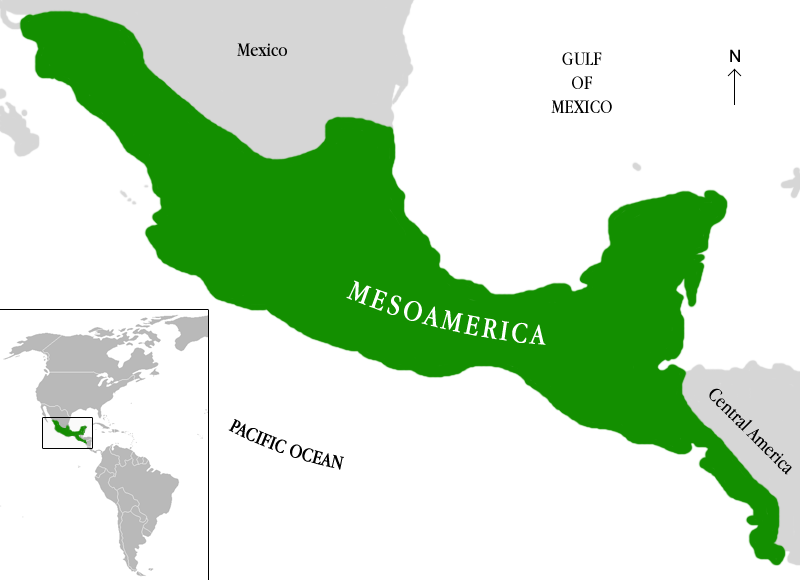
Mesoamerica relates to an area starting in central Mexcio, roughly at the Tropic of Cancer, reaching southwards almost to Costa Rica.

Source: Wikipedia


This area was home to many of the early civilizations and has seen great cultural and social changes over time. This region has enabled the development of many culturally complex civilizations, from the Omec during the Pre-classic or Formative Era (1000BC – 200AD), through to the Maya and Teotihuacan during the Classic period (200AD - 900AD) and Aztecs in the Post Classic phase (900AD - 1519AD). (Wikipedia)

Source: Maya Religion

The Mayan period stretched from 300AD - 900AD. It was a complex society with multi-ethnicity and several regional languages, religious beliefs and rituals, clothing for different activities and the technological ability to build pyramids and maintain agriculture.

Despite the complexity of this civilization, it collapsed dramatically during a period known as the Terminal Classic at 800AD - 900AD. This collapse poses one of the greatest mysteries in archaeology. Today archaeologists are still uncovering stone structures and learning about their  culture. Take a look at Mott, 2013 for National geographic for some background on the Mayans!


There are four primary theories for the collapse of the Maya: 
  1. Collapse of trade routes 
  2. Foreign invasion
  3. Epidemic disease
  4. Drought

Over my next few posts I'll look into each of these theories to discuss and assess their validity.


Till next time!


Sunday, 2 November 2014

Battle of the theories

So we've had a look at the forcing factors behind the collapse of the Akkadian Empire which occurred roughly 4,200 years ago. The most likely cause seems to be a combination of a drying climate  (Kerr,1998; more recently developed by Cullen et al., 2000) and socio-political instability with unsuitable societal response (Frahm and Feinberg, 2013).

Briefly, here are the 2 main arguments on the role of climate in societal collapse.

Environmental determinism, which is defined in the Dictionary of Human Geography, states that the environment sets limits on human society, argues that environmental conditions are the sole causational factor behind societal change allowing no place for any factors other than environmental changes. I think from what we've seen already, it’s fairly safe to say that environmental determinism overlooks other important factors and so doesn't provide a good explanation of what happened to the Akkadians (or for many other civilization collapses).

Is the success/failure of societies determined by the environment? No, but influenced by it. Source: Patrick Hardin on Cartoon stock


We can see that environmental change was not the only reason behind the collapse, even though it seems very likely to have been an influential factor.

Possibilism on the other hand may provide a more useful mind-set. Coined by Lucein Febvre in 1922, it acknowledges that the environment imposes limits on human societies and may influence the shape of cultures to a minor degree (species of grain that can be grown, native livestock, building material available), but ultimately the culture and success or failure of a society depends on its structure and response to changes.

Possibilism understands the complex nature of environment-society interactions. It is important to remember that although climate changes can cause unfavourable conditions, humans have always lived in extreme climates and continue to do so today. Therefore to say environmental change was the only factor behind collapse is an incomplete explanation.